It's official, 'Pinky and the Brain' are the policy strategists for the New American Century. They are, of course, planning world domination. However, this is a strange description. There are many in the White House and the Pentagon who fit Pinky's character, but apart from Condaleeza Rice who is a perfect lookalike for the Brain, not too many have any (brains that is.)
America is fighting what it now calls a 'long global war,' it is no longer merely the 'war on terror.' This is an even more ominous proposition than before. The USA has given itself the right to fight a perpetual global war of military, economic and cultural domination. You might say that it has always done this, albeit covertly or even deceptively, but now it has openly outlined its vision of domination in 'The 2006 Quadrennial Defense Review' (QDR).
Currently, their main overt interest is centred on Iraq and Afghanistan, but they are preparing to defend all US interests, wherever they desire, forever.
The long war is intended to extend far beyond Iraq and Afghanistan, and in common with their usual manner of operation, will include what they define as irregular warfare. In recent years, U.S. forces have been engaged in many countries to eliminate popular opposition by helping their right wing partners to police and govern their nation states for the benefit of US interests. This sphere of operations has included gun running, drug cartels and paramilitary death squads.
When Bush took office in 2001, the US was still on a redundant Cold War footing, but now they have engineered (with the help of their 'terrorist' protagonists) a terrifying era of the unexpected and the unpredictable - terrorphobia.They have used this to transform their military forces to better fit the needs of the 'New American Century.' A century of US world domination.
The U.S. global military force now emphasises its ability to to take action in so-called trouble spots across the globe.
The QDR is a reflection of the Department of Defense's thinking, and illustrates their military strategy. This includes;
A permanent US wartime footing. Peacetime planning is now considered redundant.
Actions in countries they are not at war with, but considered by the administration to be used as safe havens.
Pre-emptive aggression to shape the future for the benefit of US interests.
Massive investment into military equipment to ensure combat readiness anywhere in the world, and battle hardened forces (this of course will necessitate perpetual military actions to gain experience of warfare.)
An extension of 'multiple irregular, asymmetric operations,' an increase in covert operations, including the training and arming of various right wing paramilitary groups.
The ideas and proposals in the QDR provide 'a roadmap for change, leading to victory.' It emphasises the intention to employ client states to do more of the dirty work, and increase pre-emptive strikes. It increases the freedom of the United States and its allies to strike without consent. It seeks to sustain America’s advantage over potential competitors.
Alarmingly the intervention in countries where US prime interests may be abandoned is a primary objective. They seek to shape the choices of countries at what they call 'strategic crossroads.' Anything that opposes US demands will be nullified as official US policy.
Deterrence is to be strengthened. A wider range of conventional options in addition to nuclear deterrent will be introduced, including a small number of Trident submarine-launched ballistic missiles for use in conventional prompt global strike. There will be more use of unmanned aerial vehicles to increase persistent surveillance, and the development of the next generation long-range strike systems will begin.
'Tonight Pinky, we take over the world.'
Friday, February 17, 2006


Saturday, February 04, 2006
something thats good

We are very pleased to publicise the launch of Manny Neira's new web site called, with due modesty, www. mannyneira.com
Manny was with us at the launch of the Red Party and although we parted ways due to his ill health we are mightily chuffed that his political ideas and ours are still very close.
Unfortunately Manny remains one of the wittiest writers it has been my honour to meet, thus anyone reading this will immediately switch to www.mannyneira.com and not bother with us ever again.
Friday, February 03, 2006
water
Worldwide, there are 1.1 billion people without safe drinking water and 2.6 billion are without sanitation.
In 2002 the European Union launched its Water Initiative (EUWI) to combat this situation. It is supposed to ensure that the €1.4 billion annual water aid budget is used to its fullest effect. In order to facilitate this objective, it has five main aims. These are to;
reinforce political commitment to action;
raise the profile of water and sanitation issues;
encourage regional cooperation;
improve water governance;
gain additional funding.
However since its inception not one single extra person has received safe water or sanitation through the Initiative. The reasons for this failing are simple. The EUWI initially stalled as it took more than two years to adopt its 19 page organisational structure, and then spent its time promoting private finance initiatives despite the fact that public finance outstrips private finance by nine times in developing country water sectors.
So go on then you bastards, tell me capitalism is working. You can't even sort things out when you make the rules. Your greed driven bureaucratic failings can be counted in the millions of additional children's lives that will be lost due to the lack of safe water and sanitation.
Reference:
An empty glass: The EU Water Initiative’s contribution to the water and sanitation Millennium targets
Monday, January 30, 2006
tax burdens?
Whilst the government is seeking to reduce the financial burden caused by those claiming incapacity benefit, and encouraging everyone to work until they drop to remove the need for pensions, the Corporations are fighting to preserve their 'creative' accounting practices to maintain their profitability.
The CBI is insisting not only that the business tax burden be reduced, but that anti-avoidance taxation measures be abandoned. They claim that these proposed actions are a 'covert means of extending the tax base whilst circumventing previously accepted tax principle and practice.' Similarly they oppose windfall taxes.
Company tax avoidance practices result in a considerable reduction in expected taxation income. This reduction is, on average, nearly 6% (and rising) less corporation tax paid by the UK's top 50 companies than is expected. For the year 2004/5 this amounted to £4.6 billion lost tax revenue, and £20 billion in the last 5 years. When extrapolated to the rest of the UK's companies the tax loss could be as much as £9.2 billion per year.
There are a number of reasons for this expected, but unpaid tax. These include misleading declared tax liabilities, information hidden in the accounts in a manner to prevent interpretation, and deferred tax.
Deferred tax accounts for a large proportion of the missing tax, and has risen by £3 billion a year since 2002. It now stands at £36 billion for the top companies. The tax breaks which have allowed this £36 billion tax subsidy to business are the result of corporate tax allowances given to encourage capital investment. However, they are interest free, and have no specified repayment date. In fact deferred taxation provisions can be used whether or not there is any possibility of the amounts owed being repaid.
The European corporate world is intent on presenting a vision of capitalism with conscience, and have introduced CSR (corporate social responsibility) for its finance sector. The European economy is the second largest in the world with a GDP (gross domestic product) of $8.2 trillion, and therefore has great clout. This voluntary CSR effort has been merely a smokescreen. The finance sector is devoid of any real level of social responsibility, it is unscrupulous, corrupt and unwilling to tackle such issues as climate change, poverty, human rights and sustainable development.
The finance sector:
provides havens for the wealthy minority who siphon off cash at the expense of developing countries;
places economic benefits above the risks of climate change;
provides loans to repressive regimes which fuel bribery and corruption;
provides high interest loans to those least able to repay, thus perpetuating poverty whilst reaping record profits;
finances projects that threaten human rights; and
does not fully assess the environmental impact of the projects it funds.
Additionally competition for investment in developing countries can lead to the lowering of standards.
And so the business world continues its profit quest at will, with little heed for any other consequence. Governments are unable and/or unwilling to exercise any control, and the self regulation of greed is just a joke.
References:
CBI Recommendations For The Autumn 2005 Pre-Budget Report
Mind The Tax Gap
A Big Deal? Corporate Social Responsibility and the Finance Sector in Europe
Friday, January 27, 2006
legitimate torture
Following Hamas' success in the Palestinian elections, Jack Straw demanded that they renounce violence. He said, 'You cannot have democracy and violence.' Obviously this does not apply to the US and UK versions of democracy. Leaving aside acts of military violence perpetrated by these nations, there are also major human rights violations to consider. These are outlined in the Human Rights Watch World Report 2006.
The basic tenet of international human rights law is the absolute and unconditional prohibition of torture, and cruel, inhuman and degrading treatment. There are exceptions to the right to life, which allow killing in a time of conflict, but torture in all its guises is absolutely forbidden. However, now world powers consider torture to be a valid option. And the United States is the prime violator, ably assisted by its loyal ally the United Kingdom.
The problem is far greater than that perceived following the Abu Ghraib revelations. Those abuses were a direct result of US policy decisions that allowed interrogators a freer hand in proceedings. The decisions taken included the removal of Geneva Convention protections for war on terrorism prisoners, the adoption of a torture definition that was meaningless, and the power endowed to the US President to authorise torture.
Creating a culture for abuse however was not sufficient, detainee abuse as a deliberate policy, soon became the norm.
The United Nations’ Convention Against Torture defines the term as 'any act by which severe pain or suffering, whether physical or mental, is intentionally inflicted on a person.' However, the US defined torture as an act that caused serious physical injury so severe that death, organ failure, or permanent damage resulted in a loss of significant body function.
The US defend classic torture measures such as 'water-boarding,' a technique where the victim believes s/he will drown, and mock executions.
This stance is highlighted by Bush's avoidance of the prohibition of cruel, inhuman or degrading treatment. This is further exacerbated by Attorney General Alberto Gonzales' claim that it is permissible to use such treatment for non-Americans held outside the United States. Dick Cheney is also on record as imploring Congress to apply exemptions to the CIA from legislation to ban cruel, inhuman, or degrading treatment. Lt. Gen. Michael V. Hayden, the deputy director of national intelligence, stated that U.S. interrogators have a duty to use all available authority to fight terrorism.
Whilst the US is the only western democracy to approve the abuse of detainees, Britain has adopted policies that make it complicit. Blair has proposed the deportation of terrorist suspects to countries with well documented torture histories for such people, a full adoption of the US 'extraordinary rendition' policy (which it currently aids).
The Convention Against Torture prohibits sending people to a country where there is reason to believe that they would be tortured. However, the UK government has suggested sending their terrorist suspects to Algeria, Jordan, Libya, Morocco and Tunisia. Each of these countries are guilty of torturing radical Islamists.
In order to salve their collective conscience, Blair and his government have proposed 'memoranda of understanding,' where the recipient countries promise not to mistreat the suspect, and periodical monitoring, to validate this promise. The memoranda are useless, each of the aforementioned countries have ratified the Convention Against Torture but ignored it. This form of monitoring is also problematic. Periodic monitoring will not deny torturers opportunity, and isolated detainees have little chance of exposing their mistreatment without suffering consequent retaliation.
This course of action is incompatible with international law, and therefore Blair has sought to change the law. The Brits and the US have tried to defeat a UN resolution that stated that diplomatic assurances were not sufficient to absolve governments of their duty not to send suspects to countries where they are likely to be tortured. In the European Court of Human Rights, the UK stated that this duty should be balanced against security considerations and urged other European governments to follow their lead.
Democracy without violence, not in their world.
http://www.hrw.org/wr2k6/wr2006.pdf
Sunday, January 08, 2006
King Kong
The 1933 original of King Kong was famous not only for its ground breaking special effects but also for the multitude of subtexts that critics read into it. The monster in monster movies always represents something: it is a fear made flesh (of course, that fear is more likely to be literally made of latex), so that the films creators can consciously or subconsciously explore that fear. The original King Kong was rich in such symbolism. A feminist reading of the film reveals the way in which the depiction of the heroine portrays women as passive sexual objects. An analysis of the film sensitive to issues of race might suggest that the threat of King Kong symbolised white America’s fear of black people. Alternatively the ape’s rampage through New York might be seen as a metaphor for the damage done to people’s lives by the great depression. These are complex issues and, despite the now dated special effects; hint at the reason behind the films enduring appeal. Old movies are worth watching not just for their inherent value as entertainment (whether they are light-hearted or thought-provoking), but also because they can offer us an insight into the social context in which they were created.
The director of the 2005 remake, Peter Jackson, established his politically correct credentials in his multi-Oscar winning lord of the rings trilogy, where he beefed up the roles of a number of the women characters (women being most notable for their absence in the books), and so it is no surprise that he has made a number of changes to the story. There have not been too many changes though. Throughout the film it is evident that Jackson’s remake is very much a labour of love, with a number of direct homages to the original (although at times this verges on pastiche), and like the original, Jackson’s King Kong is all about the big ape and the special effects wizardry behind it. Kong is brought to life by Andy Serkis (who also played Gollum in The lord of the rings using the same technique of performance capture, where his gestures and facial expressions are mapped onto a computer generated character). It is his performance that makes certain that Kong dominates the film. Serkis’ expressiveness enhances the audience’s sympathy for Kong as he is captured, exploited and ultimately killed. Arguably Kong has become much more of a conscious and overt metaphor for the exploitation of the natural world/noble savage by the greedy and destructive white man. Naomi Watts’ version of Ann Darrow is similarly updated from that played by Fay Wray in the original. She is no longer a mere sex object that alternately pouts or screams; instead she sooths the savage beast through an impromptu vaudeville routine (no, seriously), and at a number of points, chooses to be with Kong.
However despite, or perhaps because, of these revisions which bring the film into line with a more contemporary morality, I found much of the film curiously unmoving. Even Jackson’s opening montage of scenes from the great depression failed to tug at the heart strings (certainly when compared with the moving way that Cinderella Man (2005) depicted the same period). A cinemagoer that is not aware of the great depression (and no doubt this includes many Americans) may be forgiven for remaining oblivious as to what is being portrayed on the screen. Where the film excels is in the wordless sequences between Ann and Kong as their relationship develops. Ann is introduced as a despondent, even nihilistic character, while Kong is a raging, savage beast, and yet through a series of deeply touching scenes, both find a kind of serenity through their relationship with one another. To my mind this retelling of the story of beauty and the beast is the heart of the film, and the film would have been much improved had Jackson spent more screen time exploring this relationship. The story of why a woman chooses the savage beast and reject the civilised man is fascinating and has generated a rich wealth of reimagined versions (even, for example, the animated Shrek films (2001 and 2004) where the princess falls in love with an ogre and embraces the ogress within herself). Jackson fails to develop this story arc to my satisfaction, and frankly cops out a bit where Ann ends up in the arms of her (human) boyfriend.
Still, Jackson clearly knows what will attract audiences to his film; breathtaking cutting-edge special effects fill up a goodly part of the films epic 3 hour 7 minutes duration. There is a stampede of apatosauruses, battles with giant bats and lots of giant creepy crawlies, and where in the original Kong battles a tyrannosaurus rex, Jackson trumps that with Kong taking on three of the brutes at once. It is all very impressive, and if you like that sort of thing then you will love King Kong. Personally, while at times I was caught up in the excitement, I found a lot of the sequences a little repetitive and at times somewhat tedious. Once you have seen one fantastic computer generated sequence the rest begin to lose their appeal in my opinion. Perhaps it is because I have become jaded by overexposure to special effects, or perhaps I am alienated from the human interest by the intervening barrier of technological wizardry, but I found myself yearning for good old fashioned films where you have to use a bit of imagination!
Ultimately a monster movie should be about something other than special effects; the monster should mean something. For example, Frankenstein is an exploration of the potential dangers of uncontrolled scientific advances; the zombies in George A Romero’s Dead films represent the oppressed underclass and so on. In his remake of King Kong I feel that Jackson has neglected the heart of the story in favour of cutting edge special effects and the end result is somewhat lacking. Frankly I think this film was made because Jackson was effectively given a blank cheque after the success of The lord of the rings which allowed him to recreate a film that he loved using the most advanced special effects available. I am not sure that is a good enough reason to make a film unfortunately.
An edited version of this review can also be read in the communist party of great britain's paper, the weekly worker at: http://www.cpgb.org.uk/worker/606/King%20Kong.htm
Saturday, January 07, 2006
big george on big brother

The apperance of the 'Worlds most important anti imperialist' the right hon G. Galloway on that prestigious television programme Big Brother should we feel be marked appropriately. Rather than sully the internet with the 'ravings of out of touch sectarians' ( that's us).
Instead, we are proud to reprint the 'authoritive voice of the anticapitalist movement', Socialist Worker, and its thoughts on Big Brother.
A SEWER FIRE HIT, socialist worker 26 august 2000 issue 1711
I HAVE a confession to make. Yes, I have found myself watching Big Brother. And I know I'm not alone.
Around six and a half million switched on to see "Nasty Nick" being given the boot. And if you want you can now get the Big Brother CD and T-shirt. The hype around this programme is immense. More people voted in one of the telephone votes to evict a competitor than took part in the elections to the Scottish Parliament.
Big Brother is the stuff of TV producers' dreams. They call it "water cooler TV". What they mean by this is that it is the TV programme we all talk about in our tea breaks at work. They encourage this by showing clips of workers all over the country talking about the show.
I was thinking of using this column to justify the reasons why I have watched the programme. My first line of defence was going to be that the programme exposes the class nature of society.
After all, isn't the main reason Nick is hated so much is because he is like a Thatcherite yuppie? Nothing was too low for this man. He even claimed his first wife was killed in an accident-a barefaced lie. The Financial Times asked various "city experts" if Nick is the kind of man needed in the City of London.
Peter Trowell, a managing director of City Jobs, said, "I think the chances of him being recruited by a London institution are zilch. "These days honesty and integrity are near the top of any job specification."
But a leading senior executive of a City PR firm let the cat out of the bag when he told the paper that Nick was ideal for a career in financial PR: "Manipulation is what it's all about in this game." Case proven.
My second argument was that Big Brother is only a game show-so what's the harm? But at the end of the day both arguments miss the point. The premise of the show is to lock people up and deny them any contact with the outside world. Then every move they make is filmed and every conversation is recorded.
If that isn't enough, on the programme's website you can log on at any time of day or night and view the contestants. There are even cameras in the toilet and shower rooms. Channel 4 has refuted the claim that the contestants are being exploited, saying all of them volunteered to do the show.
Of course they volunteered. But that doesn't make it alright. The contestants are desperate to appear on TV. They will do anything to win the £70,000 prize money or land a job as a TV presenter. The hamsters in the show have got more personality than this bunch.
The contestants are sad, vulnerable people. That's why it makes it even more disgusting to see Channel 4 taking advantage of them in order to raise its viewing figures.
Channel 4 is not just exploiting the contestants. It is debasing the viewers as well. By watching Big Brother you too become part of the dehumanising process. One last thing. The man who owns the production company that makes Big Brother is Peter Bazalgette.
The Bazalgette family made their fame and fortune in Victorian England disposing of sewage. So it's nice to see that he is carrying on the family tradition!
© Copyright Socialist Worker (unless otherwise stated). You may republish if you include an active link to the original and leave this notice in place.
Friday, January 06, 2006
subsidised free market economy
It appears that the psychopathy of the corporate profit drive knows no bounds. The free market economy that the CBI espouses is in fact nothing of the sort. In reality they want their economic opportunities fully subsidised from the public purse. Companies already benefit from low taxation, and little regulatory control, but this is not enough. They seek to maximise their profit potential by, seemingly, any means possible.
The sources of public subsidy to private profitability are many and diverse.
In the UK large payouts from the much criticised common agricultural policy are not actually going to farmers, but to companies such as Tate & Lyle, Nestle, Cadbury, and Kraft who produce refined products. Tate and Lyle, for example, received £227 million in 2003/4. Other suppliers to the processed food industry who benefited from these handouts include, Gate Gourmet and Premier Foods. Pharmaceutical companies such as GlaxoSmithKline, Boots, Reckitt, and ACS Dobfar were also beneficiaries. A similar story exists throughout Europe, large multinationals not farmers are the primary recipients of these subsidies.
The Curry Commission was supposedly initiated to aid farmers' recovery from the effects of the foot and mouth epidemic. The commission stated that the ‘key objective of public policy should be to reconnect our food and farming industry; to reconnect farming with its market and the rest of the food chain; to reconnect the food chain and the countryside; and to reconnect consumers with what they eat and how it is produced.’ £500 million was allocated to ensure that this was the case. Of course it was diverted for other uses.
Since the first report in 2002, Curry's proposals have done little to fulfill its self proclaimed prime objective, but instead have encouraged neo-liberalism in the food industry. International competition and subservience to supermarkets and other large multinational food businesses predominates.
The Food Chain Centre, run by the Institute of Grocery Distribution has been funded to the tune of £2.3 million. Tesco, Sainsbury, Asda, Compass, Nestle, Heinz, Procter and Gamble, Bernard Matthews, Kraft and Unilever, companies that are the root cause of the 'disconnection' between food producer and consumer, are the Institute's board members. The Food Centre's job is to increase company profits by reducing costs, and the bill is picked up by us, the public. Other public funding of companies' groups also exist, for example the Cereals Industry Forum, and the Red Meat Industry Forum which have also received millions.
And still the CBI want more. In fact it detailed an elaborate list in its CBI Recommendations For the Autumn 2005 Pre-Budget Report.
Further business tax cuts are demanded (both general business tax and corporation tax), a specific appeal is made to avoid 'new burdens' such as compulsory pension contributions, and further deregulation is required. They also demand enhanced business advisory and networking services, and free research from higher education establishments. Road taxes for business should be eased, but transportation systems, roads and airports, should be improved.
These business improvements are to be paid for by restricting spending on health, social security and local council services.
In summary, don't waste public finance on the people, spend it on business. And oh, we don't want to contribute to anything other than our profits.
References:
http://politics.guardian.co.uk/columnist/story/0,,1665739,00.html
http://politics.guardian.co.uk/foi/story/0,,1661500,00.html
http://www.spinwatch.org//spaw/images/artwork/Big-food.pdf
http://www.igd.com/CIR.asp?menuiD=6&cirid=1210
http://www.cbi.org.uk/pdf/pbrecon2005.pdf
Wednesday, January 04, 2006
american miners
I was looking at some of the reports about the mining deaths in the US. Bush seems to be offering very little apart from platitudes and control.
A prayer and a bullet - George's solution to the West Virginia mining disaster.
Following the disaster, the US President said that the nation was mourning the lost miners. He sent his prayers and heartfelt condolences to the loved ones. Unfortunately State troopers and an armed Swat team were also sent in, in case relatives' grief spilled over into violence.
Is that all the President of the mighty USA can offer?
Had the accident involved Haliburton's board of directors (although they are never likely to suffer more than papercuts from counting their money), I'm sure much more would have been done.
happy new year, the police have new powers
From the 1st Jan 2006 a police officer has the power to arrest anyone;
1.who is about to commit an offence
2.who is in the act of committing an offence
3.whom he has reasonable grounds for suspecting to be about to commit an offence
4.whom he has reasonable grounds for suspecting to be committing an offence
All offences are now arrestable. The triviality of the offence is inconsequential, and the final arbiter for the necessity of arrest is the arresting police officer.
Once arrested, not charged, you can be drug tested. This became law 1st Dec 2005.
Additionally the new powers introduce covert evidence gathering, including DNA, fingerprints, shoeprints and digital photographs.
A new stop and search power specifically for the under 18 year olds has been introduced, to search for fireworks.
Police may now apply for 'multi-premises' and 'all-premises' warrants which allows multiple access to premises owned or occupied by a suspect. These changes enable the police to apply for repeated entry warrants and extend the lifetime of warrants from 1 month to 3 months.
Police fishing expeditions anyone?
Thursday, December 22, 2005
attenborough and the marxists
from todays Guardian G2 section 22/12/05 written by Sam Woolaston
I saw March of the Penguins the other day, and I'm not surprised that in America it has been adopted by the Christian right. It's all about traditional family values and monogamy. These resourceful birds have even been said to be proof of intelligent design and a nail in Darwin's coffin. Well, I wonder if any Marxists out there saw last night's Life in the Undergrowth (BBC1). Because they should certainly adopt David Attenborough's programme in a similar way.
The army ants of Central America could be a model for all that Marxists believe in. They live in huge colonies in which everything is done for the common good. A million individuals collaborate and cooperate so as to form one super-organism that moves about the jungle. Everything - food, property, duties - is shared. There is no central intelligence; the behaviour of the super-organism is the cumulative result of thousands of mini-decisions by the individuals, every one of which is beneficial to the whole. Everything is sacrificed for the good of the cause. Anty establishmentarianism, I suppose it's called.
And it works. These super colonies rampage through the forest, setting up camps, using their sheer numbers to kill prey far bigger than themselves. And you know what one of these million-strong processions of aggressive army ants is called? (Warning: one more lame ant pun ahead.) Yep, an anty-war march. Sorry.
Back to the penguins for a moment. What really bothered me about that movie - apart from the married smugness of the penguins themselves - was that I wanted to know how it had all been filmed, and by whom, and how they'd coped in the freezing wastes of Antarctica. That's what's been so nice about Life in the Undergrowth: for me, the best part of the programme is the "fly on the wall" section (their pun, not mine) at the end of each show, in which Attenborough shows us how it's been filmed, and introduces us to some of the people who have done it, and the scientists. I love the insects - the ants and termites, the wasps and bees, especially the news that there are still nine million of them we don't know about yet. But even better are the people whose job it is to find them. Possibly the only thing more interesting and impressive than Titanus giganteus the Titan beetle, the largest insect in the world (it's about the size of a small pony), is Frank, the man who has devoted his whole life to finding out about it.
Sunday, December 18, 2005
reclaim our lives- no WTO
a report of anti wto protest in Reading by D o'c
RECLAIM OUR LIVES - NO WTO!
A report of the demo in Reading in solidarity with those fighting the WTO 6th ministerial in Hong Kong and around the world.
LOCAL GRASSROOTS ACTIVISTS, from Reading, Berks, came together on the 17th, in opposition to the corrupt and undemocratic World Trade Organisation (WTO) and in solidarity with all those struggling against it's policies world-wide. The various groups, fighting poverty, climate change, capitalism and more, spent several weeks discussing their plans in co-ordination with each other, and from very early on decided to hold this demonstration on commercial land owned by the Oracle shopping centre, a place where there is no legal right to protest, this was to highlight the privatisation, commercialisation and loss of open, public spaces accross the UK.
We gathered together, minutes before the demonstration, checking through who's carrying what, how many banners to take, and trying to anticipate what the security might do. When we were finally all in one place, we made our way to the Oracle Riverside, understanding the importance of getting there at once, swiftly and most importantly setting up in seconds. With hot food and drink to give out, there was a lot to carry and set up but - having the element of surprise - we were a good few seconds ahead of the security and were quickly outside Starbucks, dishing out soup made from locally grown produce, coffee which is fairly and directly imported from rebel Zapatista communities in Mexico and leaflets from teh various groups.
So what did the police actually do? Well not a lot really. They went as far as imposing "Section 14" on our demonstration, meaning simply that they put restrictions on what we could do. They restricted our numbers, saying we could not increase to more than what we had (which the officer estimated to be near 30), and gave us 15 minutes until we would be forced to disperse. A couple did leave at that point, but most stayed untill the coffee had runout and we decided to leave ourselves. On top of these restrictions, the security prevented Rising Tide demonstrators from hanging a banner off a bridge by standing on it. They even turned down our free soup and coffee! how rude!
This action was originally proposed by local anti-authoritarians RAGE at a recent local activist 'get-together' this meeting involved many groups from Reading including Friends of the Earth and Reading Peace Group to Reading Rising Tide and the Anarchist Federation. The idea behind the demo was to enable local, like minded groups to be in the same place, at the same time and in opposition to the WTO but also to reflect some of the many issues affected by WTO policies, and opinions on solutions to them. For this reason, there were leaflets and banners from these different groups, more food was genorously added to RAGE's soup.However, our real victory was not that we managed to piss the Oracle security off, but that local groups easily and happily stood alongside each other during the action. One activist stated "There is an increasing ability and willingness for different local activist groups to work across political boundaries to achieve common goals whilst maintaining their own identity".
All in all, we achieved our goal; To strike awareness of the WTO and its destructive effects in the heart of Reading's consumerist culture, the Oracle shopping centre even one Starbucks employee, who came out for a chat, expressed his support by stating "...yeah, we need to get rid of the bosses..." The very fact that we were restricted, and promptly dispersed after about an hour of demonstrating, is testament to one thing, that there is very little in the way of freedom to protest in the UK. The large companies who dominate the Oracle Riverside display their placards and adverts, so why can't we? I guess freedom of speech is like money, some people have more than others. We send our best wishes to all those hurt or arrested on the streets of Hong Kong this week, and to everyone around the world resisting capitalism.
access to medicines: only the rich
This is a story of corporate greed, and the lengths to which the world's only superpower will go to ensure its voracious appetite is assuaged. It also illustrates the folly of attempting to humanise capitalism by negotiation. Greedy bullies will not be dissuaded from their gluttony whatever the human costs.
Countries have the right to protect the public health of their population. This is set out in the World Trade Organization's Agreement on Trade-Related Aspects of Intellectual Property Rights (TRIPS). This right was reinforced in 2001 by the historic Ministerial Declaration on TRIPS and Public Health, known as the Doha Declaration. The Doha Declaration places the protection of public health over and above private commercial interests. It gives countries the right to overcome patents in order to protect public health and allow access to medicines for everyone.
However, wealthy pharmaceutical industries are not taking this threat to their profitability lying down. They refuse to accept the primacy of health over commercial interests, and are pressurising wealthy countries, the United States in particular, to negotiate bilateral and regional trade agreements that undermine the Doha Declaration. One by one, therefore, countries are trading away their people's health to the United States in deals that deliberately restrict the availability of low-cost medicines. These agreements are negotiated in secret, and are the preferred choice of industry since they bypass the compromises of multilateral negotiations.
The negotiations wholly reflect the aims of the industry representatives who advise the US Trade Representative, and seek to introduce the following provisions;
1. The transformation of national drug regulatory authorities (NDRA) into patents enforcers. Currently the procedures for the patenting and registration of drugs are entirely separate, but the US want NDRAs to prevent the registration of cheaper generic versions of a drug where a patent is already held by one of their companies. This in effect is a ban on generic versions of patented medicines.
2. The imposition of data exclusivity. This would introduce new obstacles on test data that will delay the registration of generic medicines. In order to register a medicine with a NDRA, the applicant must demonstrate that its medicine is safe, effective and of quality. However, only the first applicant must show clinical trial data to prove the drug's safety and efficacy. The US wants exclusive rights over pharmaceutical test data for originator companies. Therefore generic drug producers will have to produce their own data. This will be a disincentive and delaying factor in the production of cheaper generic drugs.
3. Extension of the length of patents. Patents on drugs usually last for 20 years from the date of filing. A patent is applied for at the basic research stage, well before the application for drug registration. Registration occurs some 2-3 years later. The US wants to extend the patent life to make up for the time between patenting, and registration. This will result in lengthening the period of monopoly.
4. Measures which will allow companies to re-patent their drug for each new use discovered. This will give companies the opportunity to perpetually renew their monopolies for that particular drug.
5. Restrictions on a country's use of compulsory licenses. Compulsory licenses allow the production or importation of a generic medicine without the consent of the patent holder. These are issued to address the requirements of public health or other emergencies. The US wants to impose strict limitations under which these compulsory licences can be issued. They propose that they are limited to declared national emergencies only.
The consequences of these restrictive practices will only serve to add to the millions who suffer chronic sickness and preventable death each year just because they are poor.
Friday, December 16, 2005
The lion, the witch and the wardrobe
Andrew Adamson (director), the chronicles of Narnia: the lion, the witch and the wardrobe, general release
The new Disney film, the lion, the witch and the wardrobe, the first of the chronicles of Narnia, is currently enchanting children and adults at the cinema… and has led to the opening of a new front in the war of words between christianity and its critics. When I first read C.S. Lewis’ the lion, the witch and the wardrobe as a child I fell in love with his magical world of talking animals, centaurs and fauns, the wicked witch and a land where it is always winter, but never christmas. It is the story of four children from 1940s England, Peter, Susan, Edmund and Lucy who discover the door to a magical land through a wardrobe, help to overthrow the wicked witch and ultimately become kings and queens of Narnia. Like many fans of the books, and, no doubt, many of the children who go to see the new film, at the time I was blissfully unaware of the christian subtext that has been the cause of controversy.
C.S. Lewis was converted to christianity by his friend J.R.R. Tolkien, and took to the faith with the zeal that only a convert can. He wrote a series of essays and books on the christian faith, notably mere christianity and the screwtape letters, in which an apprentice demon writes about his misadventures in tempting mortals. Lewis was outspoken about his faith and it was very important to him, and as such had an impact on his writing. Christian groups in the US have seized upon the new film as the answer to their prayers in combating what they see as the decline of their faith, particularly amongst the young. It has been promoted as a kind of anti-Harry Potter, good and wholesome and devoid of demonic influences and moral grey areas. Churches are encouraging their followers to block book tickets and persuade youth groups to go and see the film. Disney has colluded with this, working with a christian publishing company to promote the film in churches in the UK, and their partners in the film, Walden Media are owned by a major republican party donor. On the other side of the divide, journalist and outspoken secularist, Polly Toynbee has lambasted the film, warning us poor unbelievers to have a sickbag on hand for some of the scenes; and celebrated children’s author Philip Pullman, whose sophisticated trilogy, his dark materials, explores themes of theology, spirituality and philosophy, has denounced the Narnia books as racist and sexist christian propaganda, describing them “one of the most ugly and poisonous things [he had] ever read”. Even Tolkien purportedly was uncomfortable, and critical of what he saw as Lewis’ sermonising in the books.
So far, so straightforward. It would be easy to dismiss the chronicles of Narnia as crude christian propaganda-by-stealth, sneaking the gospel under the wary radar of children by dressing it up as an ‘innocent’ fantasy story. Some fans of the series have bent the stick the other way however, downplaying the religious themes and claiming that they are incidental to the stories. Both attitudes are mistaken, and frankly, do a grave disservice to both the chronicles of Narnia themselves and to C.S. Lewis’ faith. The christian fundamentalists may be looking for a vehicle to promote their faith, and the anti-christian lobby a means to criticise christian moralising; but if that is what they want the chronicles of Narnia to be, then in this correspondent’s opinion, both sides have backed the wrong unicorn.
Without a doubt, there are scenes and themes in both the books and the film that closely parallel christian mythology. The most obvious of these is the death of Aslan, the eponymous lion of the title, who corresponds to Jesus. He lets himself be sacrificed on a stone table by the white witch, in order to absolve Edmund of the ‘sin’ of betrayal. He is humiliated and shaved before the execution, and afterwards his corpse is wept over by Susan and Lucy. The stone table then splits in two, and Aslan is reborn. The parallels are obvious. However, despite both christian and anti-christian commentators seeking to present Lewis as being a stereotypical believer, and the chronicles of Narnia as being his attempt to proselytise to children covertly, Lewis was anything but a clichéd christian, and the Narnia books are more complex than mere propaganda. Lewis used the word ‘supposal’ to describe what he was doing with Narnia. Having invented this fantasy world, he ‘supposed’ what form Jesus would take in this world, and what form the christian faith would take. The end result can certainly be read as a form of christian apologia, and Lewis wrote that he hoped that he would introduce readers who might otherwise be resistant to aspects of christian belief, but the chronicles of Narnia are not merely christianity dressed in unfamiliar clothes, but are instead a children’s fantasy written by a devout christian, using a time-honoured device within the genre of speculative fiction, that of playing the game of ‘what if…?’, of exploring the consequences of what would happen if this was real or if that event happened.
Far from being a narrow-minded fundamentalist, C.S. Lewis’ christianity was thought-provoking and off-beat. The best example in this context is Lewis’ atypical view of paganism, which is certainly at odds with many of his fundamentalist christian supporters. He regarded paganism and christianity as having much in common, and seemed to consider pagan religions as being a kind of nascent form of christianity, arguing that it was easier for a pagan, already capable of faith in a higher power, to become a christian than it was for an atheist (Lewis wrote the Narnia books in the 1950s, at the same time that modern paganism was being reinvented and gaining followers following the repeal of the anti-witchcraft laws). This blurring of the boundaries between these traditionally opposed faith traditions can be seen in the chronicles of Narnia, where Lewis not only uses creatures from Classical, Norse and Teutonic mythology such as centaurs, dryads, fauns and dwarves, and the gods Bacchus and Silenus, but also a number of the themes in the books are arguably derived from pagan religions as well. For example, Peter is knighted ‘wolfsbane,’ because he defeats the wolf Morgrim, which echoes stories from Norse and Teutonic sagas, notably the story of the chief god, Odin fighting Fenris-Wolf at Ragnarok, the last battle. The figure of the white witch arguably corresponds to the Norse crone-goddess, Hel, who ruled over the icy afterworld Niflheim. The idea of the cyclical wheel of seasons, with winter being replaced by spring, is found in virtually every agrarian culture, for instance in ancient Greek mythology, winter is when the goddess Persephone is in the underworld, and spring begins when she returns to the surface. The theme of resurrection is similarly widespread, for example in the Classical mystery cults of Mithras, Zagreus and Orpheus, and the Norse legend of Odin dying and being reborn in order to gain knowledge of Ragnarok. Lewis’ conscious borrowing of these themes is not simply a cynical attempt to conceal his christian message, but rather is integral to his faith and his promotion of a magical view of the world in opposition to what he saw as the soullessness and reductionism of secular modernity.
Undoubtedly, a great deal of the criticism levelled at Lewis is wholly justified. The man was a sexually repressed, middle class Irish academic, who had spent decades in the seclusion of the Oxford colleges and who was writing in the 1950s. His social attitudes were representative of this background, and are reflected in his writing. Hence, the Narnia books are sexist, with women playing a subservient role; they are sexually repressed (in the last book of the series Susan is excluded from the analogue of heaven because she is interested in boys and make-up); and they are deeply deterministic, authoritarian and parochial, with the children becoming kings and queens apparently simply because an ancient prophecy says that “two sons of Adam and two daughters of Eve” are fated to do so. The portrayal of the children is also idealised - they are every middle-class parents dream - whereas in reality, as the rather more knowing fantasy writer, Terry Pratchett observes, “children mostly argued, shouted, ran around very fast, laughed loudly, picked their noses, got dirty and sulked. Any seen dancing and skipping and singing had probably been stung by a wasp.”
And yet, despite all of this, the books and the new film are deeply enchanting, and are enjoyed and often loved by children, who by and large do not become right-wing christians as a result of their exposure to Narnia. The appeal could be explained away by dismissing the chronicles of Narnia as sheer escapism, but this is too pat an answer. Fantasy is routinely described as escapist, and as the anarchistic science-fiction writer Michael Moorcock has said, “jailers love escapism. What they hate is escape.” But I would argue all good fantasy has the potential to inspire its readers to try to escape the jail of class society (and despite their faults and the conservative politics of the author, I would defend the Narnia books as good fantasy). In the film, Peter says “we’re not heroes…” and Susan jumps in with, “…we’re from Finchley.” But despite this, the children take the difficult decision to oppose the wicked witch and try to do the right thing. Lewis contrasts the fatalistic ‘grown-up’ response of accepting things as they are with the ‘childish’ optimism that you can change things for the better and it is the right thing to do. This underlying message of the chronicles of Narnia is naive but it is an uplifting and positive one, and to my mind this is the reason behind the timeless appeal of the stories.
The new film is a worthy retelling of the stories. Disney resisted the temptation to update the story or transfer it to the US, instead remaining very faithful to the books. Director Andrew Adamson has also managed the difficult task of preserving just the right amount of christian subtext, without suppressing it all together (which would miss the point) or exaggerating it in order to increase the appeal for the christian lobby (which would equally miss the point). The film was filmed in New Zealand and had a predictably huge budget, so as you would expect it is a visual treat and the special effects, the backdrops and the climactic battle are simply breathtaking. At the same time however they have managed to keep something of the naivety that is part of the charm of the books, with little known actors playing the main roles, including a particularly striking and imperious performance by Tilda Swinton as the white witch, and minor roles played by stalwart british actors Ray Winstone, Dawn French and Jim Broadbent. The film is well worth going to see in my opinion. Cynics may think it kitsch and moralising, but I found the lion, the witch and the wardrobe charming and uplifting.
An edited version of this review can also be read in the communist party of great britain's paper, the weekly worker, which is available online at: http://www.cpgb.org.uk/worker/605/narnia.htm
Wednesday, December 14, 2005
you're poor, you're ill and you won't live long
Health inequalities increased between rich and poor areas in Britain during the 1980s and 1990s. The current government has done nothing to reduce these inequalities. In fact inequalities in life expectancy, income and wealth have widened during their administration.
Twenty years ago, the World Health Organization set up Health for All 2000. 38 targets were set out to reduce inequalities in health. The main aims were;
Ensuring equity in health by reducing gaps in health status between countries and between population groups within countries.
Adding life to years by helping people achieve, and use, their full physical, mental, and social potential.
Adding health to life by reducing disease and disability.
Adding years to life by increasing life expectancy.
Recent studies have shown that the Health for All aim of reducing inequalities between groups of the population failed abysmally. In fact, the opposite occurred.
In 1997 Frank Dobson, the then secretary for health, stated, “Inequality in health is the worst inequality of all. There is no more serious inequality than knowing that you’ll die sooner because you’re badly off.”
Hazel Blears, prior to her becoming the Home Office's chief police state protagonist, said, “Tackling health inequalities is a top priority for this government.”
In 2001 two national targets for 2010 were announced;
To reduce the gap in infant mortality across social groups, and
To raise life expectancy in the most disadvantaged areas faster than elsewhere.
However, new data shows increases in health inequalities in the early years of the 21st century in the UK. Life expectancy continues to rise in the most advantaged areas of the country at a greater pace than in the poorest areas.
Income inequality has remained at its greatest for the last 20 years. These record level inequalities began in the 1980s and have continued throughout the 1990s and into the 2000s. The poorest 10% in society now receive a mere 3% of the nation’s total income, whilst the richest 10% receive more than a 25%. Income inequality is not the whole story though.
Wealth is even more unequally distributed than income. Wealth reflects lifelong circumstances, and can include savings, and other assets such as house ownership. Increasing inequality in wealth began in the 1970s, and has widened particularly since 1995-6. From 1990 to 2000 the wealthiest 10% of the population increased its share of the national wealth from 47% to 54%. The top 1 percent's share rose from 18% in 1990 to 23% in 2000. In the ten years up to 2003, housing wealth for the richest 10% of children increased by 20 times more than that for the poorest 10%.
For some health outcomes there will be a delay in terms of the effect of material circumstances. The full effects of current income inequalities on health may not be immediately visible. Wealth inequalities, however, reflect the accumulation of lifetime dis/advantage. The growing inequalities in wealth hold little hope for future trends in health inequalities, they will be transmitted to and magnified among future generations.
(Reference: Health Inequalities and New Labour: how the promises compare with real progress. Mary Shaw, George Davey Smith, Danny Dorling. Published BMJ 30 April 2005)
Saturday, December 10, 2005
Cork: thousands on the streets
Cork:Thousands on the Streets
Tens of thousands march against exploitationWorkers march to secure their rightsAt 12 O'Clock myself and Traolach stood on the bridge chatting as Cork city passed us by. By 1.30 we were swamped by thousands of our fellow corkonians. By 2.00 you could not hope to count the crowd.
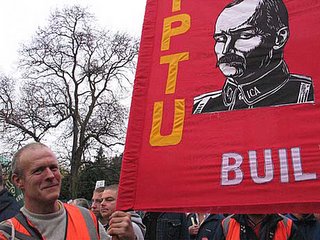
The President of the IWU said to me there were more than at the tax marches in 1979. Workers spilled onto the streets. What traffic there was ground to a halt. In our thousands we fell in behind the banners of our unions. TEEU, SIPTU, IMPACT, IWU, CWU. etc a few Starry Ploughs, Anarchist flags, Socialist party banner, Labour, Shinners.... The speakers on Connolly Hall played Luke Kelly. People shook hands met old friends made new ones. Men and women who had know hard struggle to beat poverty and oppression mingled with the children of the Celtic Tiger. There was grim determination on faces all around.
Before the march as we stood around before the crowds properly gathered, I spoke with many passersby people I had known from campaigns and issues down the years bus workers, factory workers old stalwarts and cynical young guys all worried about the turnout. It was dispelled by the flow of people like a river.
The march formed up outside Connolly Hall and on the South Mall, we joked about Mayday marches of 50 people. It took over half an hour for the first section to move off as those of us on the South Mall watched. A SIPTU steward next to me talked to one at the head of the march it stretched all the way along Merchants Quay down Pana to Daunt Square and we hadn't budged. At last we set off no chanting, no music, just banter and a feeling of confidence. Patrick Street was quieter than a wet Monday in January. The first time in a long time there were more marchers on the road than pedestrians.
We finally reached Connolly Hall. People spilled over the bridge occupied every vantage point and we listened to speeches. Trade union officials emboldened by the turnout talked tough about a battle to save our employment standards, to protect wages, to unionise immigrants , to oppose racism. The said what people had come to hear the unions live we are not brow beaten, we are strong, we are united and we will fight. Joe O Flynn SIPTU attacked IBEC, the Bank of Ireland, the government and he tore into Irish Ferries. We finished with Amhran na Fhian piped on the platform and we dispersed talking, arguing, debating a liittle spark lighted.
Now the real struggle begins between those willing to trust the trade union leadership with this and those who want to struggle to bring the unions back under the control of the members to set an agenda for not just defensive gestures but a counter offensive against the exploiters. Many workers disappointed in the past by union bureaucrats stung by the failure of their unions were there to argue for fighting unions for democracy for hope. In many hearts partnership was dead, but to make this a reality a fight for the soul of the unions will have to be fought.
text of WSM leaflet distributed at Irish demos

Workers in Irish Ferries are currently occupying their ships to prevent their jobs being replaced by super-exploted migrant workers paid less than the minimum wage. This Friday Irish unions are organising demonstrations in support of the workers but rather than calling for a stoppage they are putting the onus on individual workers or branches to attend the demonstrations. This text is a leaflet the WSM will be distributing on Friday.
Together we can beat Irish Ferries
Friday’s demonstration is an opportunity for all Irish workers to show our support for and solidarity with Irish Ferries workers in their battle against job displacement and exploitation. Their fight is our fight because if the company is successful in defeating the workers’ resistance it will open the floodgates for employers throughout the economy to slash wages and attack working conditions – a process which is already well under way.
Workers in Irish Ferries have shown the way in which employers’ attacks can be resisted. Their response to the attempts at bullying by management and their hired thugs was immediate and direct. They didn’t wait around but took immediate direct action to protect their livelihoods and force the management on the defensive. It was this action which forced the issue of job displacement on to the national political agenda and which forced the leadership of the trade union movement to take the issue seriously.
Industrial Relations Act must be smashed
Today’s demonstration is a welcome opportunity for all workers to demonstrate our support for Irish Ferries workers. But it does not go far enough. The most effective way in which all workers could show the bosses and government we intend to do more than complain would be through a national work stoppage. This would involve challenging the 1990 Industrial Relations Act which makes solidarity action unlawful.
The leadership of the trade union movement have however shirked the opportunity to challenge this anti-trade union law. Instead of issuing a direct call for all workers to walk off the job to support today’s demo, they have “requested” member unions to “maximise the participation of their members”.
Instead of this shilly-shallying, Congress should directly challenge the Industrial Relations Act. It is the strength of our numbers which would allow us to do this. If all workers across all unions took simultaneous action, it would render the law ineffective and would demonstrate clearly our potential power. If Congress are afraid to issue this call because of fears that the assets of the unions would be placed in jeopardy, why don’t they ask us – the members – what we think. After all the unions belong to the members, we should be allowed to make that decision.
Legacy of “partnership”
It is clear however that the leadership of Congress do not want to challenge the Industrial Relations Act because ideologically they are unwilling to challenge the government. This is the legacy of 18 years of so-called “social partnership” – a “partnership” which is so meaningless that employers in Irish Ferries, An Post and elsewhere can simply tear up their side of the deal at will.
It should surely be clear to everyone now that the ‘Race to the Bottom’ will only be halted by a strong fighting trade union movement. Far from “social partnership” being a means of preventing exploitation and job displacement, it has actually provided the cover which is allowing this to happen. Agreement to contracting out some work is actually part of ‘Sustaining Progress’.
It is time now that “social partnership” be consigned to the dustbin of history. We need now more than ever a trade union movement which will make a reality of the slogan of an injury to one being the concern of all. We need a trade union movement which will set itself the task of organising the unorganised, of recruiting into membership workers across all sectors of the economy who are being ruthlessly exploited. Gama, nursing homes, meat factories and many more have shown this exploitation. “Outsourcing” and other forms of exploitation will be defeated by recruiting the “outsourced” and exploited workers into the unions and fighting alongside them against that exploitation.
Seize control
All of us as trade union members must rally to this cause. We need to seize back control of our unions and we need to make those unions into fighting bodies which will stand up for the vulnerable and exploited and which will show clearly our strength in numbers.
The direct action of Irish Ferries workers has shown the way. The challenge to all of us is to ensure that their action is the spark which ignites a fight back and which demonstrates to government and employers that we will no longer tolerate the exploitation of our fellow workers
tens of thousands rally in defence of workers rights
100, 000 march through out Ireland in defence of workers rights
by sovietpop - wsm Friday, Dec 9 2005, 8:18pm From anarkismo
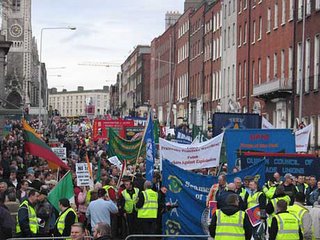
Polish, Lithuanian and Scottish workers joined thousands of Irish, as they marched in Dublin and in towns throughout the country in support of the Irish Ferries workers.
The march gathers
Irish Ferries is attempting to sack their workforce and employ instead Latvians earning below the Irish minimum wage. They intend to registor their ships in Cyprus so they can avoid Irish labour law.
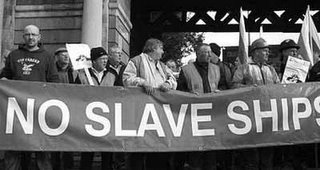
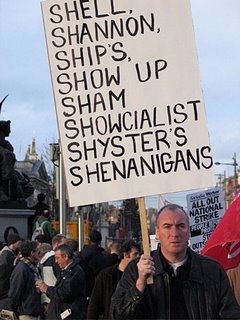
Leading the march was a banner which said 'Equal rights for all workers", closely followed by a banner reading "No Slave Ships On Irish Sea" .
Teachers, building workers, schoolchildren, air-hostesses, taxi-drivers, bus workers were among the many that marched in Dublin, as thousands walked out of their workplaces, bringing the city to a standstill.
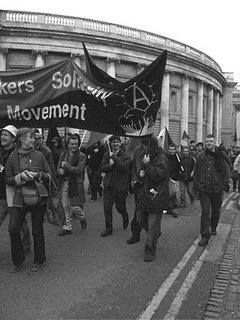
The WSM distributed leaflets and papers, and joined with other anarchists on the march.
Irish Ferries worker

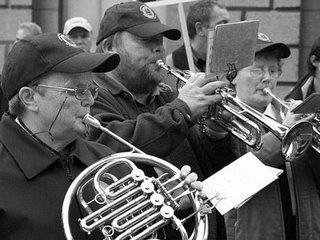
Brass band plays The Internationale
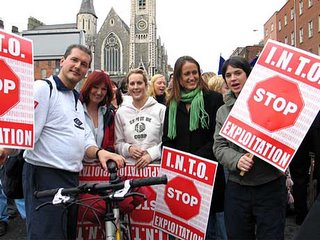
Irish National Teachers Union
Anarchist Flags

Building workers union
Globalisation in Ireland - the banner says it all
Workers Solidarity Movment Banner
School Kids

No Slave Ships
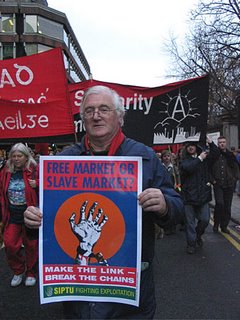
by sovietpop - wsm Friday, Dec 9 2005, 8:18pm From anarkismo
Polish, Lithuanian and Scottish workers joined thousands of Irish, as they marched in Dublin and in towns throughout the country in support of the Irish Ferries workers.
The march gathers

Irish Ferries is attempting to sack their workforce and employ instead Latvians earning below the Irish minimum wage. They intend to registor their ships in Cyprus so they can avoid Irish labour law.
Leading the march was a banner which said 'Equal rights for all workers", closely followed by a banner reading "No Slave Ships On Irish Sea" .
Teachers, building workers, schoolchildren, air-hostesses, taxi-drivers, bus workers were among the many that marched in Dublin, as thousands walked out of their workplaces, bringing the city to a standstill.
The WSM distributed leaflets and papers, and joined with other anarchists on the march.
Irish Ferries worker

Brass band plays The Internationale

Irish National Teachers Union

Anarchist Flags

Building workers union

Globalisation in Ireland - the banner says it all

Workers Solidarity Movment Banner

School Kids

No Slave Ships

Monday, December 05, 2005
reduced nativity and blasphemy
the bbc's Sunday programme has launched a 'Nativity Story in 30 seconds - that's about ninety words' competition. In the interests of brevity I found that it was possible to reduce the myth to just 8 words, but unaccountably the e-mail seems not to reach them.
so in the spirit of the Season here is the Red star commandos reduced nativity story;
A SLAPPER TELLS A WHOPPER ABOUT HER NIPPER
( awaits either lightning strike from enraged deity or, more likely knock on door from religious police)
so in the spirit of the Season here is the Red star commandos reduced nativity story;
A SLAPPER TELLS A WHOPPER ABOUT HER NIPPER
( awaits either lightning strike from enraged deity or, more likely knock on door from religious police)
Friday, December 02, 2005
more on pensions
Over the last week, more divisive mis-representations from the government have appeared regarding public sector pensions. They have attacked the '85' rule which they wish to see abolished. The rule states that where an employee's age plus his/her years of service is equal to, or greater than 85, then they are eligible to retire. The example given, by the government, is that of a person aged 60 with 25 years service retiring on full pension. This is not valid. A person may be able to apply to retire where the 85 rule is complied with, but unless a cost saving can be made by the employer, i.e. their post will be deleted on retirement, they will not be granted leave to retire. Additionally their level of pension will be restricted to be commensurate with their number of years service, i.e. not a full pension. I personally know of people who are over 60 and who have more than 40 years of service who have been refused permission to retire, even though each further year of service does not contribute to any further enhancement of their own pension entitlement.
The main gripers regarding public sector pension rights are the government, our elected representatives, and the CBI, their masters. Is it a case of envy? I think not.
An MP's pension, after 26 years service, is an indexed linked £38,000 per year. And the CBI members who wrote to complain about the current public sector pension scheme all have personal pension plans allowing them to retire at 60 on pensions 26 times the level of a public sector worker.
The average annual pension for a local government worker is £3,800.
Subscribe to:
Posts (Atom)